badchubbybunny:

nihilismpastry:

pantyanarchist:

daftqunk:

gimmeur-tots:

cygnaut:

poesieplease:

whistle-notes:

coldasaslab:

johnstamostimelessbeauty:

Here’s something to chew on.

about me.jpg

honestly

In case you wanna read the article this quote is from: http://rolereboot.org/culture-and-politics/details/2016-05-daughter-know-ok-angry/

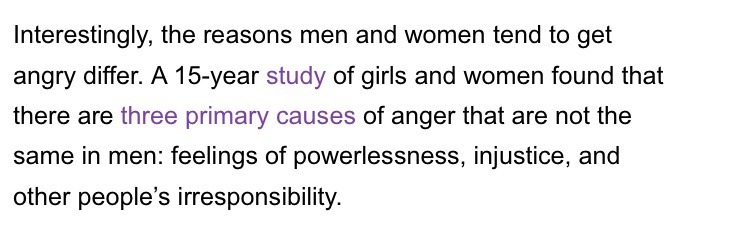
Adaptable girls find socially acceptable ways to internalize or channel their discomfort and ire, sometimes at great personal cost. Passive aggressive behavior, anxiety, and depression are common effects. Sarcasm, apathy, and meanness have all been linked to suppressed rage. Troublesome behaviors, such as lying, skipping school, bullying other people, even being socially awkward are often signs that a teenager is dealing with anger that they are unable to name as anger.

Girls, taught to ignore their anger, become disassociated from themselves.

Anger is so successfully sublimated that girls lose the ability to understand what it feels and looks like. Is her heart racing? Does she feel flushed or shaky? Does she clench her jaws at night? Is she breaking out in hives? Does she cry for no reason? Laugh inappropriately during difficult conversations? Fly off the handle over something that seems inconsequential? You can see where I’m going here…those crazy girl hormones, right? Better to just think of it as a phase.

For too many women, however, the phase never ends. It’s lives spent never expressing anger at all and believing that they don’t have the right or ability to do so without great risk.

Ok this is important. I feel like this all the time.

I really feel this. A conversation I had with my psychologist last year after I described what I thought was an anxious reaction to somehow who’d hurt me calling me randomly after over a year. My heart was racing and I was shaking and felt hot all over and was on the verge of tears, and she said. “That sounds like anger. You’re allowed to be angry.” And I became very aware that I had not been able to identify my own anger and even know what it feels like up until that point.

Just reading this makes me wanna punch something, ‘cause that’s ME. That’s exactly what I was growing up, just internalizing all the negative emotions until I couldn’t feel them. I’ve been rolling with the punches for so long and it’s so tiring, so when I do get the opportunity to express anger these days, it’s not just the current situation fueling my rage. It’s a tanker truck of repressed emotions getting poured onto the fire and boy golly do I enjoy hearing about what that looks like from bystanders of the situation.

It doesn’t happen so much anymore, but I think that’s just cause I’ve had a decent number of dumbasses choose the wrong person to fuck with. =w=

I’ve only identified anger once I’m screaming and trying to keep myself from hitting someone. I didn’t realize there was other layers to anger.

So is this why every time I think get angry/upset, all my memories from being bullied and how no adult in the school system would listen to me comes up along the way?


I dont understand how people use characters and ships for coping? I see it mentioned a lot but exactly how?

shipping-isnt-morality:

I searched through my posts and realized I don’t really have a cope shipping masterpost? So here’s the main reasons I’ve heard:

Catharsis: a literally ancient tradition of using fiction to help you feel difficult emotions, like fear, anger, sadness, or guilt, without having to confront them too directly. Sharing those emotions socially can also reduce the impact and lighten the load. For people who are dealing with totally overwhelming emotions because of trauma, catharsis is a way to bleed some of it off, maybe even in fictional circumstances similar to their trauma, allowing them to talk about it and feel it when they’re not yet ready to confront it directly. Probably most angst-shipping is in this category, and it’s by no means limited to trauma victims; anyone can benefit from and even enjoy catharsis.

Narrative Therapy: more directly relevant to survivors, this is the process of shaping what happened to them into a coherent narrative, and sorting through the ambiguities and confusion. While often “angsty”, it doesn’t have to be: I can personally testify that frequently narrative therapy is just as important for dealing with and rationalizing the positive emotions I felt during trauma.

Projection: anecdotally, many people use fiction to regain a sense of power that was lost during trauma, especially sexual trauma. These fics can go a lot of different ways: they may be virtually indistinguishable from the trauma, and overlap with narrative therapy. or they may go radically different ways: for example, the victim becoming the aggressor, or alternately the aggressor being much more aggressive and violent than they were in real life. These kind of what-ifs are a natural part of trauma, and not unhealthy if they don’t consume your life or prevent you from dealing with what actually happened.

Kink: While it’s not universal by any means, sexual trauma (especially CSA) can have a significant effect on your sexuality. Rape fantasies, CSA fantasies, all variety of transgressive sexual fantasies are more common among survivors. These fantasies are common, not harmful, and eliminating them isn’t a part of recovery unless the survivor is very distressed by them. Fiction is an easy, safe way to engage in those fantasies without creating more victims or attempting anything risky in real life.

protheangel:

fangirling-in-general-idk:

localsadsoul:

alexfierrno:

athenaowl1:

aymygod:

ghdos:

zeauxlouizianalaureate:

ramentic:

voltisubito:

marquesadesantos:

aboonoor:

If you’re a Non-Muslim and you see a Muslim praying in public, could you please not pass in front of them?

Go behind them, but not in front. 👍

Oh, signal boost! I didn’t know this.

Okay, but also: if you see a Muslim praying in public and they have something in front of them, like a purse or a bag or something like that, you can pass in front of them, but pass in front of that object.

it’s called a sutrah, and it’s meant to act as a physical barrier between the person praying and someone who might happen to pass in front.

Also, if you did this and didn’t know, please don’t beat yourself up over it. Now you know! Muslims aren’t supposed to pass in front of Muslims praying, either, because prayer is communication with God and you don’t want to break that connection.

Spread culture, respect customs, be good people. Simple as that.

Didn’t know this.

Reblogging again

THE AMOUNTS OF REBLOGS THIS HAS JUST MAKES ME SO HAPPY

S I G N A L B O O S T

Reblog forever ! 

Similarly, if a Jew is saying the Shemonah Esrei prayer (whispered, moving only the mouth, standing facing east with legs together) don’t go in front unless there’s a barrier.

^^^^

gittetj:

mainewash:

mainewash:

i still think a lot of u are blowing it out of proportion. tumblr said themselves they r working on getting the problem fixed i really dont think they would shut down the entire website just cuz the app got removed

If you’re worried about your blog, here’s what you do:

  1. Make sure you know your password and have access to the email tied to your Tumblr account
  2. If your blog is terminated, content deleted or whatever it is Tumblr’s fucking up at the moment, contact Tumblr support and tell them what happened. They should be able to restore your blog, they have done so before in other cases where blogs have been shut down on accident