I grew up believing that women had contributed nothing to the world until the 1960′s. So once I became a feminist I started collecting information on women in history, and here’s my collection so far, in no particular order.
Lepa Svetozara Radić (1925–1943) was a partisan executed at the age of 17 for shooting at German soldiers during WW2. As her captors tied the noose around her neck, they offered her a way out of the gallows by revealing her comrades and leaders identities. She responded that she was not a traitor to her people and they would reveal themselves when they avenged her death. She was the youngest winner of the Order of the People’s Hero of Yugoslavia, awarded in 1951
23 year old Phyllis Latour Doyle was British spy who parachuted into occupied Normandy in 1944 on a reconnaissance mission in preparation for D-day. She relayed 135 secret messages before France was finally liberated.
Catherine Leroy, War Photographer starting with the Vietnam war. She was taken a prisoner of war. When released she continued to be a war photographer until her death in 2006.
Lieutenant Pavlichenko was a Russian sniper in WWII, with a total of 309 kills, including 36 enemy snipers. After being wounded, she toured the US to promote friendship between the two countries, and was called ‘fat’ by one of her interviewers, which she found rather amusing.
Johanna Hannie “Jannetje” Schaft was born in Haarlem. She studied in Amsterdam had many Jewish friends. During WWII she aided many people who were hiding from the Germans and began working in resistance movements. She helped to assassinate two nazis. She was later captured and executed. Her last words were “I shoot better than you.”.
Nancy wake was a resistance spy in WWII, and was so hated by the Germans that at one point she was their most wanted person with a price of 5 million francs on her head. During one of her missions, while parachuting into occupied France, her parachute became tangled in a tree. A french agent commented that he wished that all trees would bear such beautiful fruit, to which she replied “Don’t give me any of that French shit!”, and later that evening she killed a German sentry with her bare hands.
After her husband was killed in WWII, Violette Szabo began working for the resistance. In her work, she helped to sabotage a railroad and passed along secret information. She was captured and executed at a concentration camp at age 23.
Grace Hopper was a computer scientist who invented the first ever compiler. Her invention makes every single computer program you use possible.
Mona Louise Parsons was a member of an informal resistance group in the Netherlands during WWII. After her resistance network was infiltrated, she was captured and was the first Canadian woman to be imprisoned by the Nazis. She was originally sentenced to death by firing squad, but the sentence was lowered to hard lard labor in a prison camp. She escaped.
Simone Segouin was a Parisian rebel who killed an unknown number of Germans and captured 25 with the aid of her submachine gun. She was present at the liberation of Paris and was later awarded the ‘croix de guerre’.
Mary Edwards Walker is the only woman to have ever won an American Medal of Honor. She earned it for her work as a surgeon during the Civil War. It was revoked in 1917, but she wore it until hear death two years later. It was restored posthumously.
Italian neuroscientist won a Nobel Prize for her discovery of nerve growth factor. She died aged 103.
A snapshot of the women of color in the woman’s army corps on Staten Island
This is an ongoing project of mine, and I’ll update this as much as I can (It’s not all WWII stuff, I’ve got separate folders for separate achievements).
File this under: The History I Wish I’d Been Taught As A Little Girl
Part 2
Annie Jump Cannon was an american astronomer and, in addition to possibly having one of the best names in history, was co-creator of one of the first scientific classification systems of stars, based on temperature.
Melba Roy Moutan was a Harvard educated mathematician who led a team of mathematicians at NASA, nicknamed ‘Computers’ for their number processing prowess.
Joyce Jacobson Kaufman was a chemist who developed the concept of conformational topology, and studied at Johns Hopkins University before it officially allowed women entry in 1970.
Vera Rubin is an astronomer and has co-authored 114 peer reviewed papers. She specializes in the study of dark matter and galaxy rotation rates.
Mary Sherman Morgan was a rocket scientist who invented hydyne, a liquid fuel that powered the USA’s Jupiter C-rocket.
Chien-Siung Wu was a physicist who worked on the Manhattan Project, as well as experimental radioactive studies. She was the first woman to become president of the American Physical Society.
Mildred Catherine Rebstock was the first person to synthesize the antibiotic chloromycetin.
Ruby Hirose was a chemist who conducted vital research about an infant paralysis vaccine.
Hattie Elizabeth Alexander was a pediatrician and microbiologist who developed a remedy for Haemophilus influenzae, and conducted vital research on antibiotic resistance.
Marie Tharp was a scientist who mapped the floor of the Atlantic Ocean and provided proof of continental drift.
Mae Jamison is an astronaut who holds a degree in chemical engineering from Stanford University and was the first black woman in space.
Ada Lovelace was a mathematician and considered to be the world’s first computer programmer.
Patricia E Bath is ophthalmologist and the inventor of the Laserphaco Probe, which is used to treat cataracts.
Barbara McClintock won a Nobel prize for her discovery that genes could move in and between chromosomes.
That’s it for now, part three will be on its way. (Josephine Baker was requested in the first installment, just know I did not forget her! She’s in a different folder, titled ‘famous people you didn’t know were complete badasses, and she, along with Hedy Lamar and Audrey Hepburn will be in the next installment 🙂 )
Ikonik
Time to get over the “women can’t do that” syndrome. We can do anything, and have!
I did the math. If I do a load of laundry every week (I technically have to do two, as my undershirts are washed at a different temperature and air dried), so its $6 a week. That’s $312 per year. There are six units in my building, assuming they are spending the same on average (but probably more), that’s $1872 per year that my landlord pulls in. I can FRIGGIN GUARANTEE YOU that the collective building *DOES NOT* spend $1872 per year in water and power to run the washer and dryer. I also pay $1200 per month in rent, which is $14,400 per year. Between 6 units that’s $86,400, plus the laundry fees lets call that $88k that the building pulls in per year. I can FUCKING GUARANTEE YOU this building does *NOT* use that much in water and property taxes, and every unit pays for its own electricity.
My landlord owns 10 buildings, all of the same design. The entire lot of 10 buildings has one superintendent. The buildings do not have AC, their appliances have not been replaced in a minimum of 20+ years, and the washer and dryer are…well they’re ancient.
I feel *ZERO* sympathy if I can make this work in the laundry room.
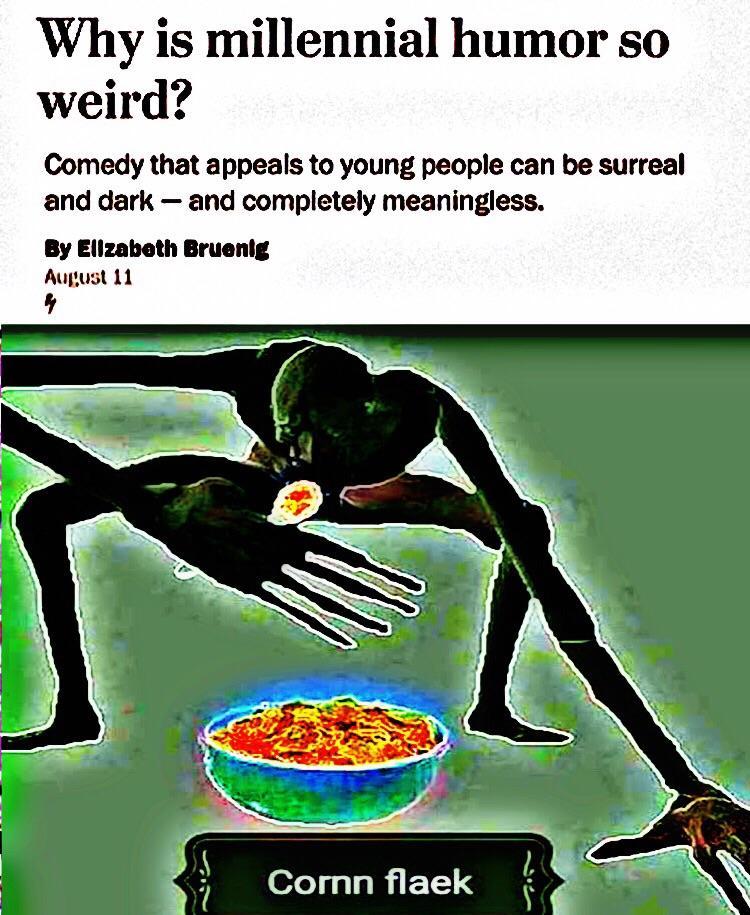
it’s because reality is terrifying and our world’s dying, and our developmental years were spent in a constant state of using increasingly nonsensical humor to cope
It’s called the rise of neo-dadaism and the same thing happened during WWII
well that’s not concerning At All
The same thing also happened in the rise of Surrealism in the art word post WWI.
You ever see those photos of a super expensive piece of art that’s just the Mona Lisa with a mustache glued on her? Or just a toilet in a modern art museum? That’s literally where it comes from.
However I feel a big difference is also this; the rise of dada especially is from the mindset that something as horrible as the allowing the first world war to happen means humanity has no inherent value, and therefore nor does its art.
However, in Millenial humour, another big factor is the rejection of using racism/sexism/exclusionary and insulting language as a crutch for humour. As a result, the appeal of surrealist humour has become much more prevailant.
So basically; Millennial humour is a a form of rebellion and counter culture movement to what the generation before saw as “valuable” while also being a progressive step towards not building humour on the concept of harm. WHich, in of itself, is ALSO counter cultural to many events we are exposed to in today’s society.
When you hit your elbow against something, but that specific point of your elbow
it’s…called your funny bone…
that gif tho
It’s not a bone actually- it’s a nerve that is exposed, specifically the ulnar nerve. The reason it feels so weird to hit it is that it’s not designed to deliver pain signals, so when you hit it it just wiggs out and sends Garbage signals to the brain, and the brain is just like “uh, dude- Ulnar, what the hell is this garbage?? You’re supposed to curl a finger and a half, and move some muscles in the forearm, why are you sending me this crap? How am I supposed to make this into sensory output?” And the Ulnar nerve is just like “dude dude dude, brain- what the hell is going on?!?” And the brain goes- “idiot. Fine. You’re on fire, freezing and being electrocuted. Happy?” And the Ulnar goes “holy crap brain!! I’m on fire, freezing and being electrocuted! What am I going to do!!??!” And the brain says “you’re an idiot ulnar. A damn idiot.”
Saying “Fuck it” actually motivates me more than “You can do this”.
Because saying “fuck it” includes the total acceptance of failure as the outcome, meanwhile “you can do this” focuses only on the hopes of a successful outcome and the lack of acknowledgement of the equally probable failure outcome induces a certain level of unspoken anxiety














 Marshmellowmilktea